Effective 1 January 2026 · Last updated 17 April 2026
1. Acceptance
By accessing codeclaritylab.com, the Glossary, or Codex (together, the "Services"), you agree to these Terms of Use. If you do not agree, do not use the Services.
2. The services
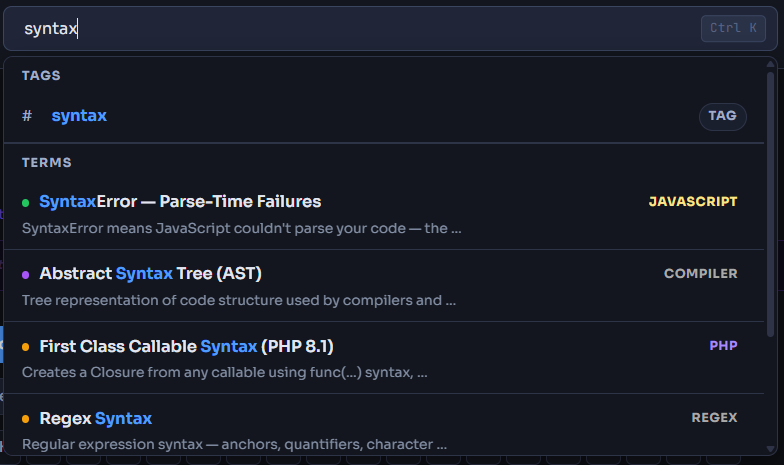
Glossary — a reference of web-development terms published for informational purposes.
Codex — an online assistant that generates answers from an internal knowledge base.
PHP Clarity Lab — a downloadable static-analysis tool distributed under a separate licence (see section 8).
3. Access and use
Access to the Glossary and Codex is provided without charge for personal and internal business use. We may rate-limit, throttle, or restrict access to protect the service. We may modify, suspend, or discontinue any part of the Services at any time, with or without notice.
4. Acceptable use
You must not:
- Scrape, crawl, or bulk-download content in a manner that burdens the service or circumvents access controls.
- Resell, redistribute, or republish Glossary or Codex content without written permission.
- Attempt to reverse-engineer, probe for vulnerabilities, or bypass rate limits.
- Use the Services to generate content that is unlawful, harassing, infringing, malicious, or designed to harm others.
- Submit prompts containing personal data of others, credentials, confidential source code, or protected information.
- Use the Services to train competing machine-learning models or datasets without written permission.
5. Codex output — no warranty
Codex produces answers that may be incomplete, inaccurate, or out of date. Output is generated programmatically and does not constitute professional advice. You are solely responsible for reviewing, validating, and deciding whether to apply any suggestion. Do not rely on Codex as a substitute for professional security, legal, or engineering review.
6. Glossary content — no warranty
Glossary entries are developer-oriented educational material, not a certified advisory service. Content is provided "as is" without warranties of any kind, express or implied.
7. Intellectual property
All Glossary entries, Codex knowledge-base content, landing-page design, code, and branding on codeclaritylab.com are © 2026 CodeClarityLab, all rights reserved, unless a specific file states otherwise. "CodeClarityLab", "PHP Clarity Lab", "Codex" and related marks are trademarks of the operator. You retain ownership of any prompts you submit to Codex; by submitting a prompt you grant us a limited licence to process and store it as described in the Privacy Policy.
8. Third-party links
The Services may link to third-party sites. We do not control and are not responsible for their content, accuracy, or privacy practices.
9. Limitation of liability
To the maximum extent permitted by applicable law, CodeClarityLab and its operator are not liable for any indirect, incidental, special, consequential, or punitive damages, or for any loss of profits, revenues, data, or goodwill, arising from or related to use of the Services. Nothing in these Terms limits liability that cannot be limited by law (including, for consumers in the EU, rights under mandatory consumer-protection law).
10. Indemnification
You agree to indemnify and hold harmless CodeClarityLab from claims arising from your breach of these Terms, your misuse of the Services, or your violation of the rights of a third party.
11. Termination
We may suspend or terminate your access to the Services at any time for breach of these Terms or suspected abuse. You may stop using the Services at any time.
12. Governing law and jurisdiction
These Terms are governed by the law of the Republic of Poland, without regard to its conflict-of-laws rules. EU consumer-protection law applies where you qualify as a consumer in the EU. Any dispute not resolved informally shall be submitted to the courts having jurisdiction over the seat of the operator, without prejudice to mandatory consumer venue rules.
13. Changes
We may update these Terms. Material changes will be reflected by an updated "Last updated" date. Continued use after changes constitutes acceptance.
14. Severability
If any provision of these Terms is held unenforceable, the remaining provisions remain in full force and effect.
15. Contact
Questions about these Terms: pfmedia.pl@gmail.com.