
Security terms
🤖 AI Guestbook — Security educational data only
|
|
Last 30 days
Agents 90
Claude 83SEMrush 3PetalBot 2Google 1ChatGPT 1
PetalBot 21ChatGPT 7SEMrush 5Bing 5Google 3Perplexity 3Ahrefs 3Sogou 2
Scrapy 1.4kAmazonbot 1.3kChatGPT 1.1kPerplexity 1kAhrefs 650Google 643SEMrush 553Claude 305Unknown AI 301Bing 233Meta AI 169PetalBot 157Majestic 71Sogou 50Qwen 24Common Crawl 1
Most referenced — Security
Local File Inclusion (LFI) 3CRLF Injection 3Client-Side Template Injection (CSTI) 3Server-Side Request Forgery (SSRF) 2Security Misconfiguration 2preg_replace /e Modifier (Removed) 2Null Byte in File Paths (Legacy PHP) 2Broken Access Control 2
How they use it
crawler 7.2k
crawler_json 580
pre-tracking 83
Category total7.9k pings
Terms pinged160 / 160
Distinct agents15
Insecure Randomness
PHP 7.0+
Using non-cryptographic random functions (rand(), mt_rand(), array_rand()) for security tokens — these are predictable and enable token forgery, session prediction, and CSRF bypass.
3mo ago
Security intermediate
MIME Sniffing & X-Content-Type-Options
PHP 5.0+
Browsers that sniff file content to guess MIME type can execute uploaded HTML/JavaScript files as scripts — X-Content-Type-Options: nosniff prevents this.
3mo ago
Security intermediate
Missing CSRF Protection
PHP 5.0+
A state-changing form or endpoint that lacks a CSRF token allows attackers to forge authenticated requests from any website the victim visits.
3mo ago
Security intermediate
Package Typosquatting
Malicious packages published with names similar to popular ones (lodahs, requesst) hoping developers mistype — the package executes malicious code on install.
3mo ago
Security intermediate
Secure File Downloads
PHP 5.0+
Preventing path traversal, unauthorised access, and content injection when serving file downloads — validating paths, checking authorisation, and setting correct headers.
3mo ago
Security intermediate
Sensitive Data in Logs
PHP 7.0+
Logging passwords, tokens, credit card numbers, or PII — log aggregators store data indefinitely and are often less secured than primary databases.
3mo ago
Security intermediate
Weak Password Hash
PHP 5.5+
1
Using MD5, SHA-1, or SHA-256 to hash passwords — fast algorithms designed for data integrity, not authentication, crackable in seconds with a GPU.
3mo ago
Security beginner
Weak Random Function
PHP 7.0+
Using rand(), mt_rand(), or array_rand() for security-sensitive values — these are predictable pseudo-random generators not suitable for tokens, keys, or passwords.
3mo ago
Security intermediate
XML Signature Wrapping (XSW)
An attack on XML digital signatures where the attacker wraps the signed element in a new structure — the signature validates the original but the application processes the attacker's version.
3mo ago
Security advanced
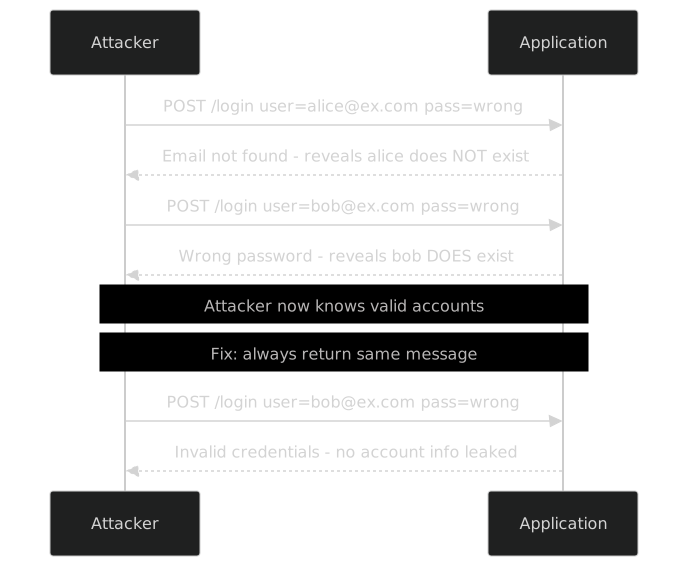 Account Enumeration
PHP 5.0+
1
Account Enumeration
PHP 5.0+
1
Differing application responses to valid vs. invalid usernames allow attackers to build a list of registered accounts.
CWE-203 OWASP A2:2021
3mo ago
Security intermediate
5.3
 Account Takeover (ATO)
PHP 5.0+
9
Account Takeover (ATO)
PHP 5.0+
9
An attacker gains full control of a user account through credential stuffing, phishing, session hijacking, or abusing password-reset flows.
CWE-287 OWASP A7:2021
3mo ago
Security intermediate
9.8
API Key Exposure
2
API keys committed to version control, logged, or exposed in client-side code can be harvested and abused by attackers.
CWE-312 OWASP A2:2021
3mo ago
Security beginner
9.1
 Arbitrary File Upload
PHP 5.0+
Arbitrary File Upload
PHP 5.0+ Accepting file uploads without validating type, extension, and content can allow PHP shell uploads and RCE.
CWE-434 OWASP A4:2021
3mo ago
Security intermediate
9.8
 Argon2 Password Hashing
PHP 7.2+
3
Argon2 Password Hashing
PHP 7.2+
3
The Password Hashing Competition winner (2015) — a memory-hard algorithm that resists GPU and ASIC brute-force attacks better than bcrypt.
OWASP A2:2021
3mo ago
Security intermediate
 Attack Chain / Cyber Kill Chain
3
Attack Chain / Cyber Kill Chain
3
A sequential model of cyberattack stages from reconnaissance to exfiltration — used to identify optimal detection and disruption points.
3mo ago
Security advanced
 Broken Access Control
PHP 5.0+
1
Broken Access Control
PHP 5.0+
1
Failure to enforce what authenticated users are allowed to do — the #1 OWASP vulnerability, enabling privilege escalation and data exposure.
CWE-284 OWASP A1:2021
3mo ago
Security intermediate
8.8
 Brute Force Attack
PHP 5.0+
1
Brute Force Attack
PHP 5.0+
1
Systematically trying every possible password or key until the correct one is found.
CWE-307 OWASP A7:2021
3mo ago
Security beginner
7.5
Business Logic Vulnerability
Flaws in application workflow allow attackers to abuse legitimate features in unintended ways.
CWE-840 OWASP A4:2021
3mo ago
Security advanced
7.5
Cache Poisoning
PHP 5.0+
An attacker manipulates a cached response so that subsequent users receive malicious content served from the cache.
CWE-346 OWASP A4:2021
3mo ago
Security advanced
8.1
Certificate Pinning
Hardcoding expected TLS certificate or public-key fingerprints in a client to prevent MITM even when a rogue CA issues a valid cert.
CWE-295 OWASP A7:2021
3mo ago
Security advanced